For many Coimbatore SMEs, wholesalers, distributors, and dealers, the relationship with a customer doesn't end when an invoice is generated.
It actually begins there.
A product is sold.
Then, a few weeks or months later:
"Sir, the product is not working."
The customer sends a WhatsApp message.
A salesperson asks for the invoice.
The customer sends a photo.
Someone searches Excel.
Another employee checks the ERP.
Someone calls the manufacturer.
The manufacturer asks for the serial number.
The customer calls again.
"Any update on my service?"
This may sound like a small operational problem.
But when a business handles hundreds or thousands of products, warranty and after-sales service can become a major operational burden.
For growing SMEs in Coimbatore, this is where a proper warranty management and after-sales service system can make a significant difference.
Why Warranty Management Is Becoming a Problem for SMEsCoimbatore has a strong ecosystem of manufacturers, wholesalers, distributors, dealers, and engineering businesses.
Many businesses sell products that require:
- Warranty support
- Installation
- Periodic service
- Repairs
- Spare parts
- Technician visits
- Product replacements
- Manufacturer coordination
The challenge is that the information required to manage these activities is often spread across multiple places.
Customer complaints and service conversations.
Excel
Warranty records and service tracking.
Manufacturer communication and approvals.
ERP
Invoices and sales information.
Phone Calls
Technician and customer coordination.
Manufacturer Portals
Warranty claims and service requests.
The result?
The business has information—but doesn't have a single source of truth.
7 Major Warranty & After-Sales Problems Faced by Coimbatore SMEs1. Warranty Claims Are Managed Manually
A customer may provide:
- Invoice
- Serial number
- Product photos
- Purchase date
- Complaint details
Employees then manually verify whether the product is still under warranty.
As the number of customers increases, this process becomes difficult to manage.
A warranty management system can automatically connect the product, invoice, serial number, customer, and warranty period.
2. WhatsApp Becomes the Service Management System
For many SMEs, WhatsApp is the easiest way for customers to communicate.
But WhatsApp conversations are not a proper service-management system.
Important information can become buried under hundreds of messages.
A customer may say:
"I sent this yesterday."
The employee has to search through conversations to find it.
With after-sales service software, every request can become a service ticket.
The business can track:
Customer → Product → Warranty → Complaint → Technician → Spare Part → Resolution
in one place.
3. Customers Keep Calling for UpdatesOne of the biggest hidden costs of after-sales service is repetitive communication.
Customers repeatedly ask:
- Is my warranty approved?
- When will the technician come?
- Is the spare part available?
- When will my product be repaired?
- Has the replacement been approved?
- When can I collect the product?
Employees spend valuable time answering the same questions.
With automated notifications, customers can receive updates when the status changes.
Claim Received
↓
Warranty Verified
↓
Technician Assigned
↓
Service Scheduled
↓
Spare Part Required
↓
Repair Completed
↓
Service Closed
This improves the customer experience while reducing repetitive work for employees.
4. Technician Management Becomes DifficultWhen service requests increase, simply assigning jobs through phone calls or WhatsApp is no longer enough.
Businesses need to know:
- Which technician is available?
- Where is the technician located?
- What product does the technician specialize in?
- Which service requests are pending?
- Which jobs are overdue?
- How many jobs were completed?
- How long does each repair take?
A technician management system gives managers visibility into the entire service operation.
5. Spare Parts Cause Service DelaysSometimes the technician identifies the problem immediately.
But the repair still cannot be completed because a spare part is unavailable.
Without proper tracking, employees may not know:
- Which part is required
- Who requested it
- Whether it is available
- Where it is located
- Whether it has been dispatched
- Which customer/service ticket needs it
Connecting spare-parts management with service tickets helps businesses identify exactly where a service request is stuck.
6. Manufacturer Coordination Takes Too Much TimeFor distributors and wholesalers, warranty service often involves multiple parties:
Customer
↓
Dealer
↓
Distributor
↓
Manufacturer
↓
Service Center
↓
Technician
↓
Customer
When every party communicates separately, delays become difficult to identify.
A centralized service workflow gives the distributor or wholesaler a clear view of the claim and its current status.
7. Business Owners Don't Have Real-Time VisibilityThis is perhaps the biggest problem.
An owner may ask:
"How many warranty claims are currently open?"
Someone has to check Excel.
Then:
"How many are overdue?"
Another search.
"Which manufacturer has the most pending claims?"
More manual work.
"Which products are generating the most service requests?"
More analysis.
A proper after-sales service dashboard can provide these answers instantly.
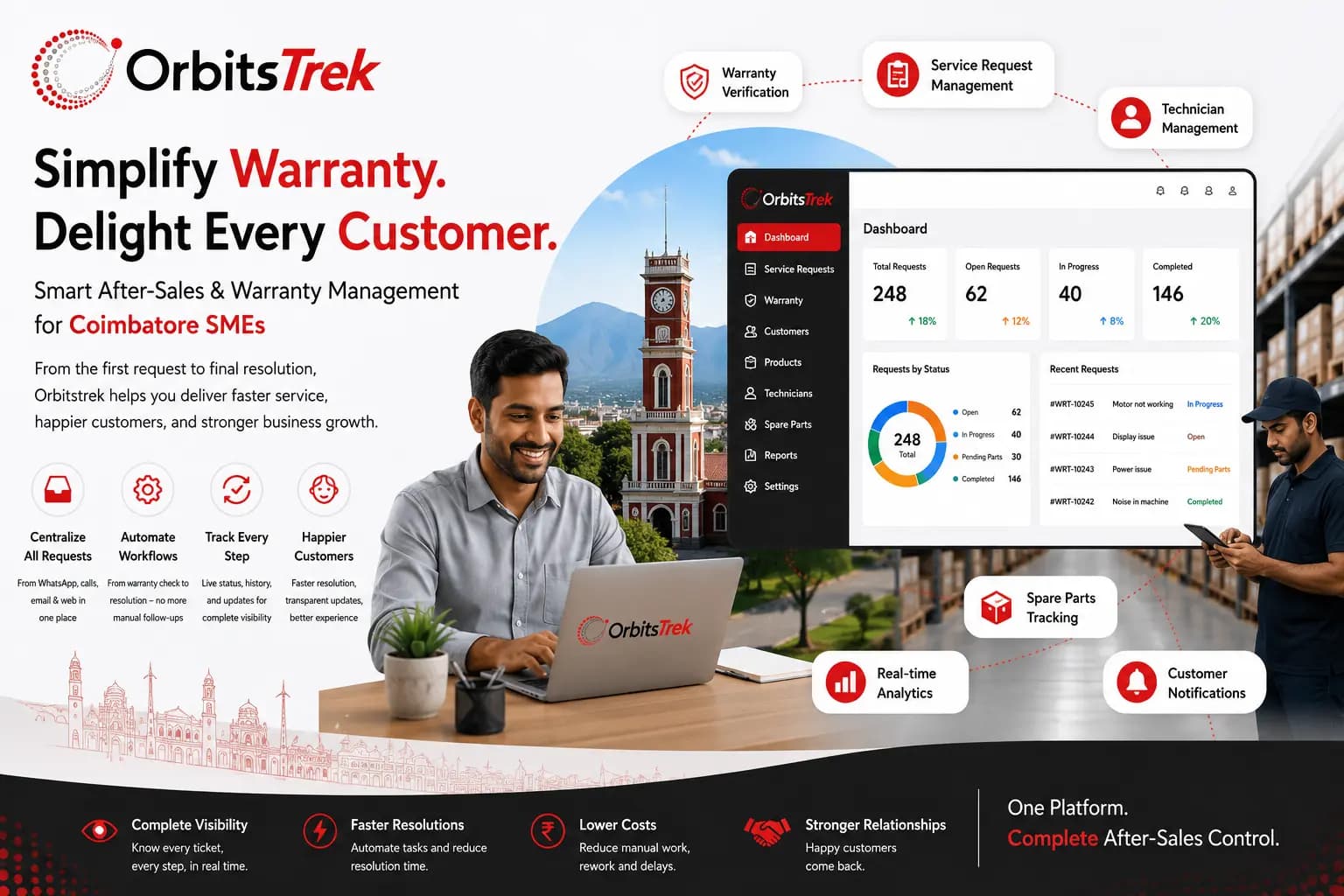
How Orbitstrek Can Help Coimbatore SMEsOrbitstrek can bring the entire warranty and after-sales operation into one platform.
Instead of managing:
WhatsApp + Excel + Email + Phone Calls + ERP + Manufacturer Portals
businesses can manage the service lifecycle through one centralized system.
The Orbitstrek Service Journey
Step 1 — Customer Raises a Request
A customer can submit a service or warranty request through the available business channels.
The request becomes a ticket.
Step 2 — Product & Warranty Verification
Orbitstrek connects the request with:
- Customer
- Product
- Serial number
- Invoice
- Purchase date
- Warranty period
The team can quickly determine whether the claim is eligible.
Step 3 — Automatic Ticket Creation
Every complaint gets a unique service ticket.
For example:
Ticket #WRT-10245
Customer: ABC Traders
Product: Industrial Equipment X200
Serial Number: XXXXX
Warranty: Valid
Priority: High
Status: Technician Assigned
Step 4 — Assign the Right Technician
The service team can assign the request based on:
- Location
- Product expertise
- Availability
- Priority
Step 5 — Track Spare Parts
If a part is required, the requirement can be linked directly to the service ticket.
This makes it easier to identify service delays.
Step 6 — Keep the Customer Updated
Customers can automatically receive important status updates instead of repeatedly contacting the business.
Step 7 — Close the Service
Once the repair or replacement is completed, the service report and customer confirmation can be recorded.
The complete history remains available for future reference.
One Product. One Customer. One Complete History.Imagine a customer purchased a product two years ago.
Instead of asking an employee to search through old Excel files and WhatsApp conversations, the business can view the complete history in one place.
Customer
ABC Traders
Product
Industrial Equipment X200
Serial Number
SN-2024-XXXX
Purchase
15 January 2026
Warranty
Valid until 15 January 2027
Previous Services
3 service requests
Current Request
Motor issue
Assigned Technician
Ravi
Spare Part
Motor Assembly
Current Status
Awaiting Spare Part
This is the kind of visibility growing SMEs need.
Why This Matters for Coimbatore BusinessesCoimbatore's business ecosystem includes a wide range of companies dealing with:
- Industrial equipment
- Electrical products
- Pumps
- Motors
- Machinery
- Electronics
- Medical equipment
- Home appliances
- Engineering products
- Automotive components
- Commercial equipment
- Other warranty-based products
For these businesses, after-sales service is not simply a support function.
It is part of the product experience.
A company that sells a good product but provides poor after-sales support can still lose customers.
On the other hand, a company that provides fast, transparent, and professional service can build stronger customer relationships.
From Warranty Management to Customer RetentionWarranty management shouldn't only be about resolving complaints.
It can also become a source of business intelligence.
With structured service data, SMEs can identify:
Which products fail most often?
Which manufacturers create the most warranty issues?
Which spare parts are frequently required?
Which technicians resolve cases fastest?
Which customers generate recurring service requests?
How long does it take to close a warranty claim?
Where are service delays happening?
This information can help management make better decisions about inventory, purchasing, suppliers, products, and customer relationships.
The Future of After-Sales Service for SMEsAs SMEs grow, managing customers through spreadsheets and scattered WhatsApp conversations becomes increasingly difficult.
The next step is not necessarily hiring more people.
It is automating repetitive processes and giving existing teams better visibility.
That's where a platform like Orbitstrek can help.
Automate the repetitive.
Centralize the information.
Track every service request.
Keep customers informed.
Give managers real-time visibility.
Turn after-sales service into a competitive advantage.
Is Your Business Still Managing Warranty Claims Through WhatsApp and Excel?If your team spends hours searching for invoices, checking warranty dates, calling technicians, following up with manufacturers, and answering customers asking for service updates, it may be time to rethink the process.
Orbitstrek helps SMEs bring warranty, service requests, technicians, spare parts, customer communication, and after-sales operations together in one platform.
Don't just manage the sale.
Manage everything that happens after it.
Orbitstrek — Built to Power Your Growth.